
The Real Cost of a Coding Bootcamp
Let me rebuild your mental model of the bootcamp market, because the numbers most people carry around are several years out of date. A full-time, in-person bootcamp in the United States now typically runs anywhere from $12,000 to $25,000 for a twelve-to-sixteen-week immersive program, with big-name schools like General Assembly, Flatiron, and Fullstack Academy clustering toward the top of that range. Income Share Agreements, once the totemic "pay nothing upfront, pay 17% of income later" model popularized by Lambda School (now Bloom Institute of Technology), have largely retreated amid regulator scrutiny and repayment disputes, leaving tuition and financing plans as the dominant structure. The market has consolidated too: a wave of closures and acquisitions has thinned the field since 2023, which changes how you should evaluate job-outcome claims.
Against that backdrop, the honest question is not "do bootcamps work?" but "does this bootcamp work for someone with my background, budget, and goals?" A bootcamp can be the fastest structured route from zero to your first junior engineer role, and it can also be a $20,000 mistake if you choose the wrong kind of program for your learning style. This guide walks through the decision factors and the comparison data so you pick based on evidence instead of advertising.
What a Bootcamp Actually Teaches You
Bootcamps compress what a university covers over two years into a few months by cutting theory and doubling down on applied skills. Expect a heavy dose of JavaScript, HTML, CSS, React for the front end, and Node.js or Python for the back end, plus Git, SQL, and at least one deployment workflow. What you generally will not get is deep computer-science theory, algorithms, data structures, or the math that a CS degree covers. You get project-based reps and a portfolio, which is precisely what many hiring managers screen for at the junior level.
That portfolio matters more than the certificate. Employers vary on how much they weight bootcamp credentials, but they are nearly unanimous in wanting to see working code you built and can explain. Which is why the best bootcamps are the ones that force you to ship incomplete, messy, real projects rather than polished toy tutorials. If a program hands you a completed project walkthrough and calls it your portfolio, that is a warning sign, not a feature.
Comparing the Major Programs
There is no single best bootcamp, only the right fit for your constraints. Consider timeline seriously: a 12-week full-time program is a drastically different commitment from a 9-month part-time program, and your life circumstances will determine which is even possible. Consider delivery mode too. Hybrid and online-flex programs have matured considerably since the pandemic, and many now offer the same curriculum with lower cost and more schedule freedom than fully in-person options.
| Platform / Tool | Key Features | Pricing |
|---|---|---|
| General Assembly | Full-time/part-time web dev, career services, alumni network, industry-led curriculum | ~$16,450 for full-time SEI; financing available |
| Flatiron School | Software engineering & data science, structured cohorts, career coaching | ~$16,900; scholarships and financing |
| Fullstack Academy | Full-time/part-time, immersive web dev, strong job-search support | ~$17,980; income share options |
| Codesmith | Intensive, high-selectivity, focuses on JavaScript depth and CS fundamentals | ~$19,950 for 13-week full-time |
| Springboard | Self-paced with 1:1 mentorship, structured curriculum, job guarantee | ~$8,400 for online, deferred tuition |
| CareerFoundry | Mentor-led online, flexible pace, project portfolio, job guarantee | ~$7,900 for full web dev program |
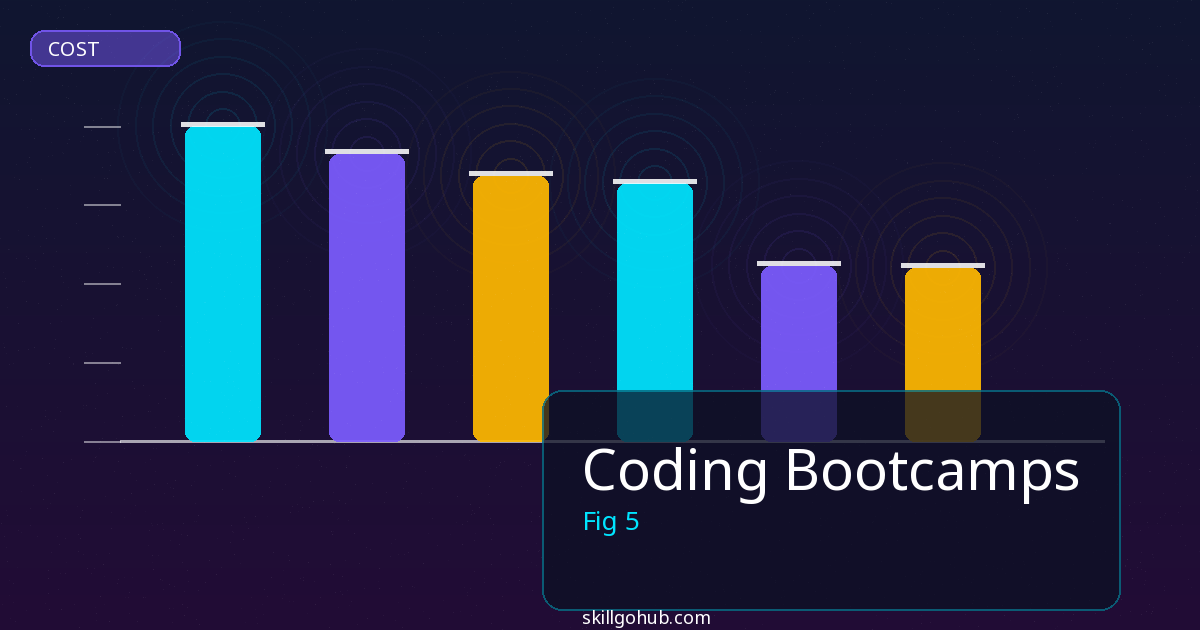
Notice the spread. You can pay roughly $8,000 for a solid mentor-led online program or roughly $20,000 for an intensive, high-selectivity immersion. The higher price tag does not universally buy a better outcome. It tends to buy structure, pace, selectivity of peers, and intensity. Decide which of those you actually need, then filter by price.
Are You Cut Out for a Bootcamp Pace?
A 12-week full-time bootcamp expects you to code like it is your job, because after graduation it will be. Classes run deep into the evening, weekends are for projects and reading, and the pace simply does not tolerate falling a week behind. If your only available time is a couple of hours after work on weeknights, a full-time intensive is a recipe for burnout and wasted tuition. That learner should pick a part-time or self-paced mentor model instead.
Conversely, self-paced models reward exactly the discipline they fail to enforce. I have seen motivated students sail through a mentor-led program in four months, and I have seen the same program take a year because absences stacked up. Be brutally honest about your self-management. If you have never finished a long-term self-directed goal, choose the structure that forces accountability: fixed cohort, live classes, and deadlines you cannot quietly move.
The Job Placement Question Nobody Wants to Ask
Bootcamps advertise placement rates, and you should interrogate them hard. Schools often report outcomes only from students who actively participate in job search after graduation, and that denominator can materially inflate the number. Ask for the raw numbers: how many students started, how many finished, and of the finishers, how many were employed in the field within six months in the role they paid to train for, not just "employed."
Market realities matter too. The junior developer market tightened meaningfully through 2023 and 2026 as companies favored more experienced candidates, and bootcamp grads felt that squeeze more than CS grads. A bootcamp is a lever, not a guarantee. It shortens the time to competence dramatically, but it does not spare you from a competitive hiring market, and it cannot compensate for a weak portfolio or no relevant side projects. If you enter without any programming exposure at all, seriously consider spending a few weeks on self-study first. The students who thrive in a bootcamp are usually the ones who already built a small app on their own and are now paying to go faster and deeper. If you are still deciding whether the field is for you, a lightweight guide to whether and how to learn coding before you spend thousands will pay for itself many times over.
Financing, ISAs, and Budget Reality
The financing structure changes your risk. Upfront tuition is the simplest and the least risky for you, but it requires liquidity. Monthly or deferred tuition shifts the cost later but can add interest or repayment obligations regardless of job outcome. Income Share Agreements sound attractive until you read the fine print: a fixed percentage of income for a fixed number of months, often with a cap, and usually without the flexibility to negotiate when the employment picture is bad.
Here is the arithmetic to run before signing. Take the all-in cost, add the likely repayment, then divide by the realistic monthly salary increase the bootcamp unlocks, and ask how many months of earning that difference repays the investment. For someone jumping from $40,000 to a $75,000 engineering salary, an $8,000-to-$20,000 bootcamp repays itself quickly. For someone already near an engineering salary, or uncertain about finishing, the math gets much harder to justify. Crunching that number honestly before you enroll beats rationalizing it after.
Do You Even Need a Bootcamp to Break In?
The uncomfortable truth is that the structure of a bootcamp is the product as much as the curriculum. Everything it teaches is, technically, free to learn online, and a meaningful number of developers break in without ever paying for a bootcamp by building a strong open-source portfolio and a network. But "technically free" undersells the real cost of self-direction: no deadlines, no curriculum order, no instructor to unblock you, and no career-services pressure to keep you applying. For most people, that structure is worth real money.
The rise of AI coding tools has also changed the calculus. Assistants now handle a lot of the boilerplate that once consumed early bootcamp weeks, which means curricula that still spend a month on syntax are not keeping up. The most forward-looking programs now teach you to build with AI as a force multiplier rather than teaching you as if AI did not exist, and they fold prompts, review loops, and tooling into every project. If you are choosing between programs, ask how they teach modern tooling, and review how AI coding tools reshape the skills a junior needs before you commit to a curriculum built on the old assumptions, then cross-check that program's daily rhythm against what a serious self-led learner gets out of the best structured learn-coding roadmaps.
Choosing Between Self-Study, Bootcamp, and a Degree
Set the three paths side by side and the tradeoff snaps into focus. A four-year computer science degree gives you depth, theory, and the strongest credential, but it costs tens of thousands of dollars and four years of your time. Self-study costs nearly nothing but demands uncommon discipline and leaves you to organize your own scaffolding and job search. A bootcamp sits in between: significant cost, short timeline, structured curriculum, and a built-in accountability and career-support loop.
The deciding factor is usually constraints, not quality. If your time is more precious than your money, a full-time bootcamp is attractive. If money is tight and you have steady willpower, self-study wins. If you are young, have the time and money, and want the deepest foundation, a degree still holds an edge, especially for visas and large employers that filter by formal credentials. None of these is objectively better; each is better for a different set of circumstances.
Making the Final Call
Before you enroll, do three concrete things. First, build one small project entirely on your own, even if it is imperfect, to confirm you enjoy sustained problem-solving, because bootcamp is sustained problem-solving at speed. Second, talk to two or three graduates from your shortlisted schools and ask the uncomfortable questions about placement and honesty, not the marketing ones. Third, read the financing agreement line by line with a cold eye on the worst-case scenario, and decide you can absorb it. If you clear those three bars, a bootcamp can be the fastest, most direct route into a genuinely rewarding career. If you are brand new and unsure, a few structured weeks of basics will tell you a lot, and a guide to covers exactly that first stretch without spending anything. Do the prep, then decide with your eyes open. And if the self-driven basics feel overwhelming rather than motivating, a structured primer on gives you the exact on-ramp to try before you commit a single dollar.
For more, check out: .
For more, check out: , and .
Frequently Asked Questions
Is a coding bootcamp worth it if I already have a non-tech degree?
Often yes, provided you go in with a realistic timeline. Your degree signals you can finish long commitments, and bootcamps care far more about your applied projects than your major. The main risk is the hiring market: a bootcamp alone rarely compensates for a thin portfolio, so build side projects during the program and network actively. Plan for three to six months of job hunting after graduation, not a guaranteed same-week offer, and the investment math usually works out if engineering salaries are your target.
Bootcamp placement statistics look great. How do I know they are honest?
Ask for the formulas behind the numbers. Legitimate programs publish the share of all enrolled students (not just graduates) who are employed in the field within six months, and they disclose response-rate caveats. Be suspicious of placement rates reported only on students who completed and actively job-searched, since that denominator filters out dropouts and non-participants. Cross-check on LinkedIn by finding recent grads from your cohort year and asking directly what they experienced; that is the most reliable data you will get.
Can I really learn enough in 12 weeks to get hired as a junior developer?
Yes, for the right learner in the right market condition, but it is a ceiling, not a baseline. Twelve weeks produces capable web developers fluent in a modern JavaScript or Python stack, with a portfolio to show for it. Landing the first role depends on the local job market, your background, and your follow-through on projects and networking. Entry-level demand has tightened since the 2021 hiring boom, so treat the bootcamp as the start of your learning, not the finish line, and keep building after you graduate.
What is the difference between a bootcamp certificate and a computer science degree?
They are different instruments. A degree covers theory, algorithms, systems, and formal computer science for four years and is widely recognized by large employers and employers that sponsor visas. A bootcamp certificate proves a few months of intense, applied, project-based training in a specific stack. Many employers respect bootcamp grads for practical skill, but some still filter on the degree for junior roles. If you already hold a bachelor's in anything, a bootcamp can be a fast bridge into engineering; if you have no degree at all, the degree often opens more doors long-term.
How much time should I spend self-learning before enrolling in a bootcamp?
At least a few focused weeks, and ideally enough to build one small, working project on your own. Doing this confirms three things before you spend thousands: that you enjoy the problem-solving, that you can sustain self-directed effort, and that you understand the absolute basics, which lets the bootcamp start at full speed instead of waiting for you. Students who arrive already able to build a simple CRUD or freeCodeCamp project consistently report less stress and better outcomes than absolute beginners who begin from zero on day one.