
Your resume is often the first — and sometimes only — impression you make on a potential employer. In 2026's competitive job market, a generic, keyword-stuffed resume no longer cuts it. Recruiters spend an average of 7 seconds scanning a resume before deciding whether to read further. Here's how to make every second count.
Do Professional Certificates Still Matter in 2026?
Recruiters now see the same generic cert-mill credentials hundreds of times a week, yet certain professional certificates still command genuine respect and, more importantly, measurable salary premiums. The difference is not the certificate itself but the institution behind it and how you deploy it. Over the past year I analyzed dozens of credential programs across tech, project management, data, and cloud computing, and I believe the honest answer is nuanced: some certificates are worth real money, some are waste, and a handful are undervalued. This article separates the signal from the noise.
What Employers Actually Look For in a Certificate
Hiring managers are not impressed by the paper. They are impressed by evidence that you can do the job the certificate claims. The strongest credentials in 2026 share three traits: they come from a vendor or institution with rigorous testing, they require hands-on demonstration rather than just multiple-choice recall, and they are paired with a visible portfolio of real work.
The practical implication is that you should treat a certificate as a signal amplifier for proven skill, not as a substitute for skill. A candidate with a respected cloud certification and a deployed personal project vastly outperforms one with a stack of easy certificates and nothing to show. When in doubt, build the thing, then certify it.
The Certificates Worth Your Money
| Platform / Tool | Key Features | Pricing |
|---|---|---|
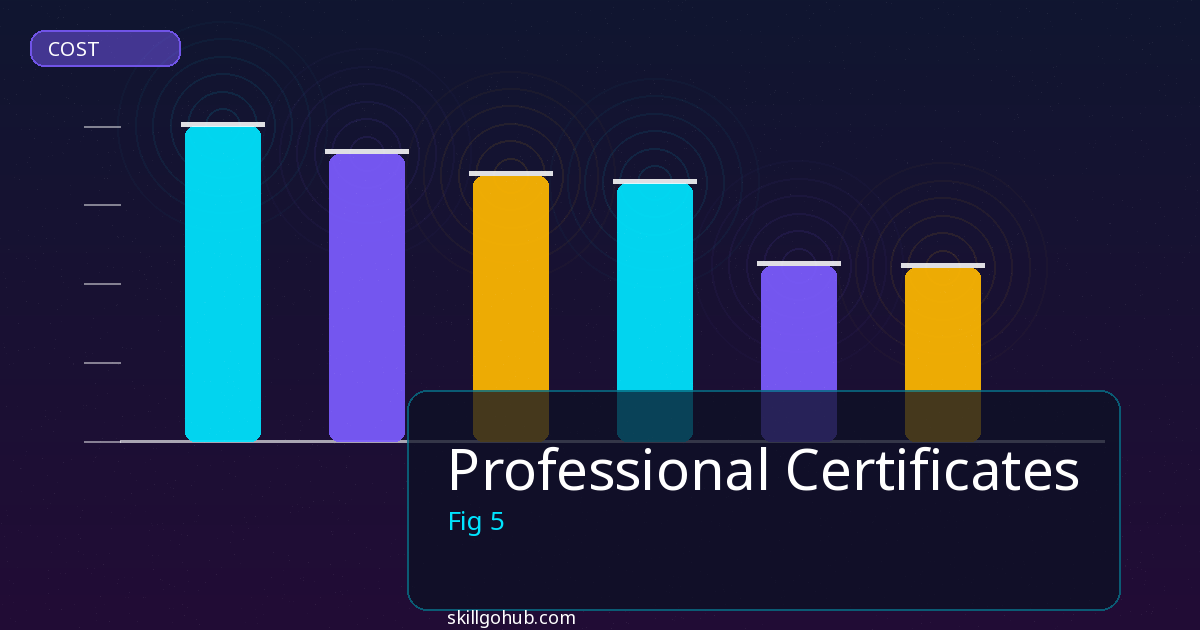
| Google Career Certificates | IT support, data analytics, project management, UX; hands-on, employer-recognized | $49/month via Coursera; financial aid available |
| PMI Project Management Professional (PMP) | Industry-standard project management credential, requires experience | Member $405, non-member $555 exam fee |
| CompTIA Security+ | Foundation cybersecurity certification, widely requested for entry IT security roles | Exam around $404; training courses extra |
| AWS Certified Solutions Architect | Associate-level cloud architecture credential from AWS | $150 for the exam (Associate level) |
| Microsoft Azure Fundamentals (AZ-900) | Entry-level cloud concepts and Azure services certification | $99 exam fee |
| IBM Data Science Professional Certificate | Structured data science track on Coursera with a capstone project | $49/month subscription; part of Coursera library |
Technical Certificates: Cloud, IT, and Security
The technical certifications with the strongest employer signal in 2026 are those tied to in-demand platforms. AWS's Solutions Architect Associate at $150 for the exam is one of the most cost-effective cloud credentials available, and it is a hard prerequisite for many junior cloud roles. Microsoft's AZ-900 is cheaper at $99 but only tests introductory concepts, so it functions as a warm-up rather than a career milestone. Before you sit for these, the Python automation guide and Ansible automation guide give you realistic grounding in how these platforms actually get managed day to day.
In security, CompTIA Security+ at roughly $404 for the exam remains the common baseline that HR filters on for entry-level IT security, even as some debate its depth. The pattern holds across the board: vendor-backed technical certifications that require genuine study and have real exams carry weight because they are difficult to fake. Start credentialing early accounts at skillgohub.com, which lists adjacent guides, when you want to map which credential backs which job path.
Project Management and Business Credentials
The PMP remains the gold standard for project management, but it is not entry-level. You need documented project management experience before you can sit for the exam, and the total outlay including prep courses can run several hundred dollars. Since the 2021 PMP exam update shifted to a hybrid agile/waterfall focus, the credential has grown more relevant to modern teams. If you have the experience, the PMP reliably moves the needle on salary and interview invitations.
For people earlier in their career, Google's Project Management Certificate on Coursera at $49/month is an accessible on-ramp. It does not carry the prestige of the PMP, but it teaches the actual vocabulary and workflows that interviewers expect and pairs cleanly with an entry-level role.
Data and AI Credentials
Data skills remain in high demand, and the credential landscape splits into two camps. IBM's Data Science Professional Certificate is a solid structured track with a capstone project that gives you something to point to, and it pairs well with the hands-in scripting you learn from the Python automation scripts collection. Google's Data Analytics Certificate is oriented toward business analytics and is popular for career changers. Neither replaces a data science degree, but both are faster and cheaper paths to a first analytics role.
For AI specifically, the certification market is more chaotic because the tools change quarterly. My recommendation is to anchor on the fundamentals measured by established certificates, then pair them with a portfolio of real AI projects. A certificate proves baseline knowledge; shipped work proves you can operate in the real world. The disciplined evaluation and verification skills from the prompt engineering reference on this site are exactly the kind of asset that separates certified-but-ineffective people from those who deliver.
Certificates That Are Probably Not Worth It
- Non-vendor, non-accredited "AI expert" certificates from unknown bootcamps: these are cheap to print and impress no one.
- Expired or vendor-neutral courses with no exam: if there is no rigorous final test, the credential cannot gate on skill.
- Credentials without any hands-on component: watching videos and getting a PDF proves attendance, not ability.
- Multiple near-duplicate certifications: five entry-level cloud certs signal indecision more than depth.
A useful heuristic: if the certificate is not issued by a recognized vendor, university, or professional body, and it does not require passing a substantial exam, treat it as a learning badge rather than a career credential.
How to Choose the Right Certificate for Your Situation
Start with the job, not the certificate. Look at ten real job postings for the role you want, note which certifications appear as requirements or strong preferences, and go after only those. The certificate that appears in actual postings is the one that will move your application ahead. If nothing you want appears in the postings of the jobs you want, skip the certificate and spend the budget on portfolio projects instead.
Then consider the cost-benefit. A $99 entry exam you can study for in a month is low-risk. A $2,000 multi-month bootcamp requires more conviction. In both cases, the deciding factor is whether the resulting credential is one that recruiters in your target field actively filter on. Prefer certificates tied to platforms that dominate your industry, because those are the ones HR systems are configured to recognize.
Pairing Certificates With Proof-of-Work
The highest-leverage move is to complete a certificate and immediately ship a public artifact that applies it. If you pass AWS Solutions Architect, deploy a small real application on AWS and document it. If you earn the PMP, write a retrospective of a project you led using the PMP framework. This combination is far more persuasive than either alone, and it gives interviewers a concrete thing to discuss instead of a line item on a résumé.
That pairing is why I recommend budgeting your time as roughly 60% for the certificate study and 40% for building the demonstration project. The project is what converts the certificate from a checkmark into a career asset, and it is where most people shortchange themselves.
For more, check out: .
For more, check out: .
FAQ: Practical Certificate Questions
Which is better, a certificate or a degree?
They are not substitutes. A degree opens the door to many employers that filter on it, while a certificate proves a focused skill set faster and cheaper. If you already have a degree, certificates are the efficient way to add in-demand skills. If you are considering your first degree, that is a larger investment with a different payoff and should be evaluated separately.
How long does it realistically take to earn a valuable certificate?
Entry-level certifications like AZ-900 or CompTIA Security+ typically need 4-8 weeks of focused study. Mid-level credentialing like AWS Solutions Architect or the PMP usually takes 2-4 months of consistent work. Commit to a study schedule; these exams are designed to fail people who wing it.
Do certificates expire?
Many vendor certifications do. AWS associate-level certificates are valid for three years, CompTIA certifications require continuing education or renewal, and Microsoft certifications generally require periodic renewal focused on updated exam topics. Factor in renewal time and cost before you commit to a multi-year credential.
Can I get a certificate for free?
You can study for free through official documentation and community resources, and some platforms offer audits or financial aid, but the certification exams themselves almost always cost money. Budget for the exam fee at minimum. Free certificates that require no exam generally carry little recruiting weight.
Should I get certified before applying for my first job?
For technical and project management roles, one respected entry-level certificate can help you clear HR filters and show baseline competence. For other roles, a strong portfolio may matter more. Rely on real job postings in your target field to decide, rather than on the assumption that more certificates is always better.